Viral Flying Car Puts Alef Aeronautics and Its Founder, a Former DJ, to the Test
Alef Aeronautics' demo video has drawn millions of eyes and thousands of preorders, but founder Jim Dukhovny still faces regulatory, financial and engineering hurdles before the car can reach customers.
By Mei Ling ·
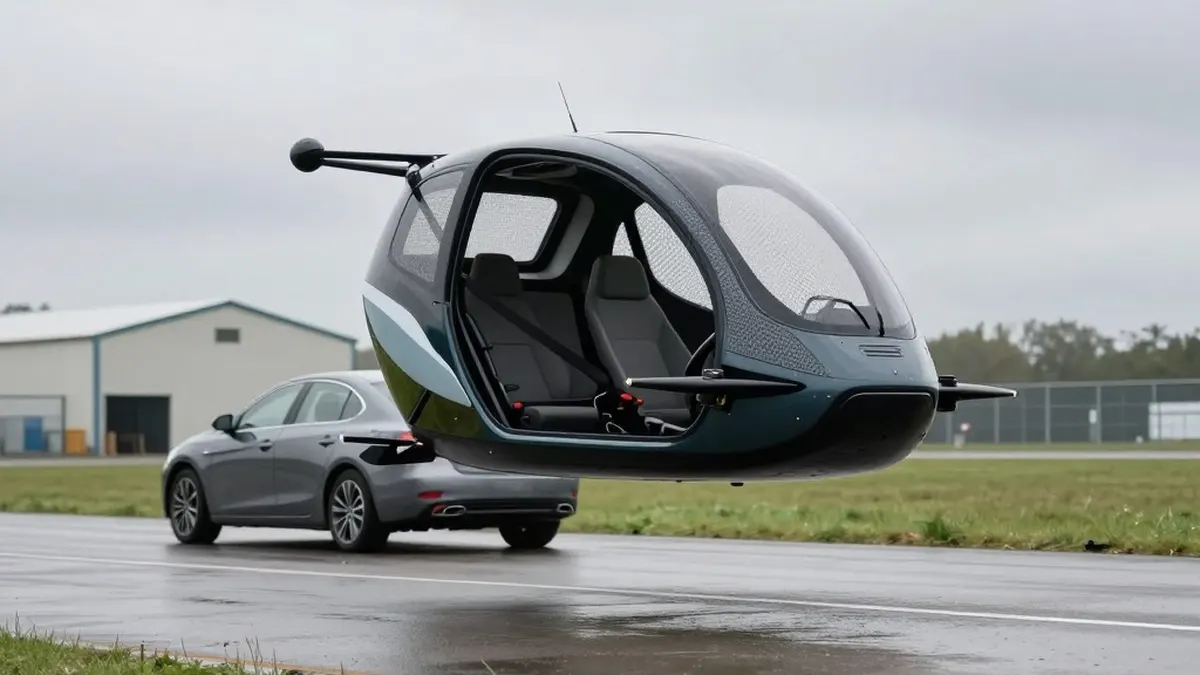
A video showing a lightweight, ghostly-looking vehicle rising off the ground and passing over another car has turned a small San Mateo startup into an internet sensation. Alef Aeronautics, founded by Jim Dukhovny, now says it holds more than 3,000 preorders, worth close to a billion dollars, for a car that has yet to carry a passenger.
The attention has been intense in recent weeks. HBO's John Oliver devoted a segment to the company on March 2, likening its flagship car to something that looks like Lightning McQueen "got canceled and rebounded by starting his own energy drink company." TMZ later told Dukhovny that Alef's demo clip was the most viral video of the day. Online reaction has been mixed, with some viewers guessing the car was a drone in a car-shaped shell and others suspecting an AI-generated fake. Dukhovny's answer is that people should "believe their eyes."
Dukhovny, a former software engineer who also worked as a San Francisco nightclub promoter and DJ under the name "DJ Wizard," founded the company in 2015 after sketching the idea with four friends at a Palo Alto coffee shop. He says they predicted six months of work. A decade later, the vehicle is priced at $300,000, though he hopes to eventually sell it for $30,000. He kept the project so private that his father, who inspired it, did not know about it before dying in 2022.
Venture capitalist Tim Draper, an early backer of Tesla and SpaceX and also of Theranos, became the largest investor after Dukhovny cold-emailed him nearly ten years ago. Draper confirmed the investment and wrote that he expects "to be flying into my own parking space within the decade." Other backers include Jim Boettcher of Focus Ventures and Eric Ball of Impact VC. Boettcher said the company has raised only $8 million so far, a modest sum for a decade-old firm that would need billions if it reached mass production. He praised Dukhovny as frugal and adept at using college interns, though he acknowledged that even his wife doubts the venture will work.
The company is guarded about its technology. It has said only that the car has four small engines at its wheels, with a propeller, motor and battery systems filling the open space, and a mesh on top that holds the structure while letting air through. Reporters have not been allowed inside the vehicle, and an NBC crew filming the demo was kept about half a football field away. Dukhovny cites the company's seed-stage status and says he cannot afford to reveal everything. Test flights are also delayed after heavy rain because the test field gets too soggy, and he says Alef cannot afford another field.
Regulation poses a further obstacle. The demo model weighs under 250 pounds, within the FAA limit for a lightly regulated ultralight aircraft, but the consumer version is planned at more than 800 pounds. That would still count as an ultralight in the U.K. and Canada, Dukhovny notes, but ultralights are barred from flying over heavily populated areas in those countries. He expects many buyers to live in rural places served by a single road, where hopping over a fallen log or rockslide could matter. "It's limited," he admits, "but it's a good first usage." Alef plans to begin producing the first car by early next year. A spot on the preorder list costs only $150.
Competitors are moving as well. Aska in Mountain View, Samson Sky and China's Xpeng are all working on flying vehicles, and Xpeng has announced plans to begin mass production next year. Joby Aviation and Volocopter are developing piloted air taxis. The market's viability is also uncertain: Kitty Hawk, a flying car company backed by Larry Page, abandoned one of its most promising models three years ago, saying it "could not find a path to a viable business."
Dukhovny frames the project as bigger than business. He argues that time is among the world's most valuable resources and that people lose roughly a week every year to traffic. Whether his car can deliver that time back, he says, is something people will have to see for themselves.
Source: The San Francisco Standard